
Exercise:
Validate
Under
Pressure
A CIRT that is not exercised is not operational.
You can have a plan, defined roles, and a well-structured team — and still fail when an incident hits. Why? Because incident response is a team sport, and teams that have never played under pressure will struggle when it counts. A tabletop exercise puts your plan to the test in a controlled environment, revealing gaps before a real attacker does.
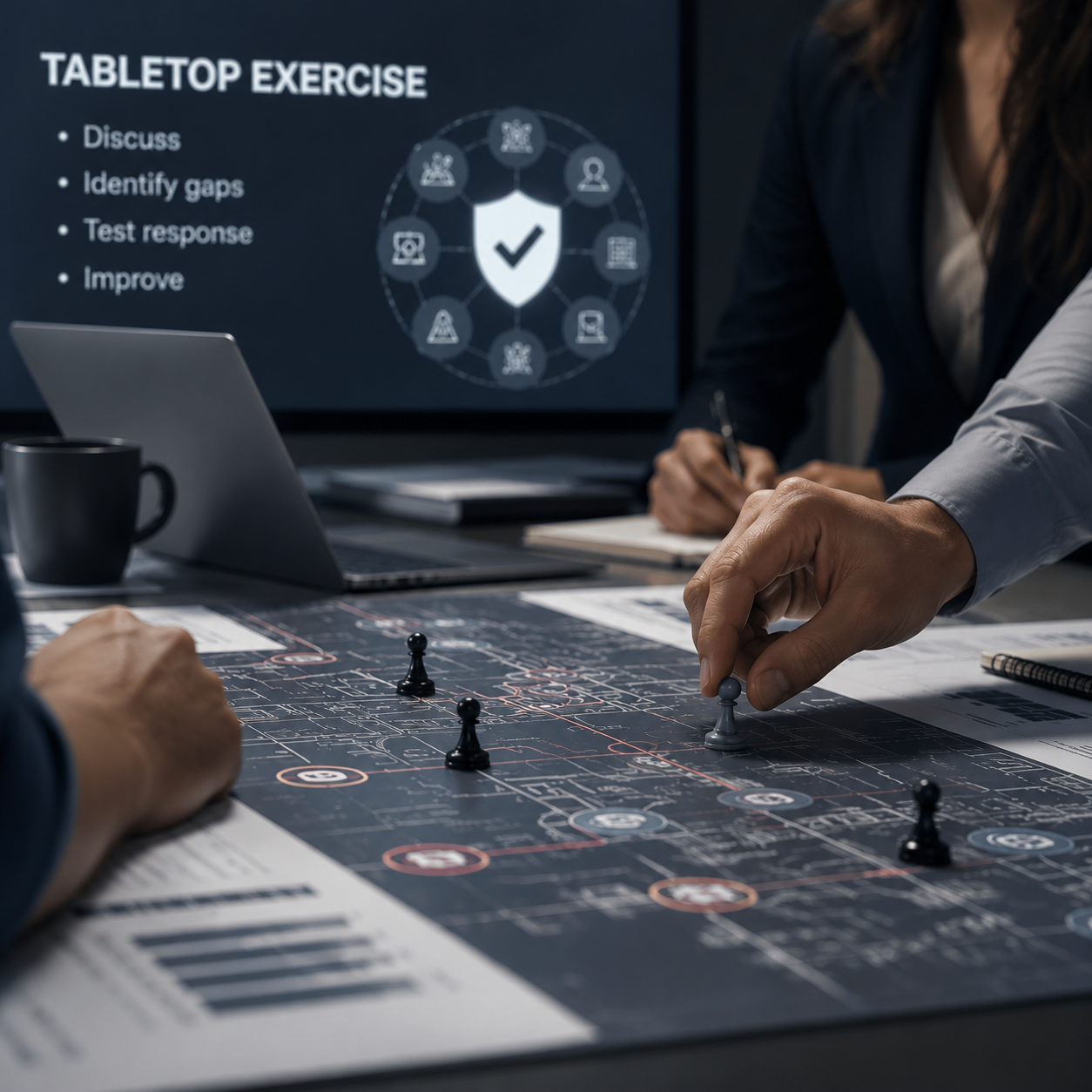
Incidents don't wait for readiness.
When a ransomware attack locks your systems, or an insider quietly exfiltrates data over weeks, your organization must respond — fast, coordinated, and with confidence. The difference between a contained incident and an operational crisis often comes down to one thing: whether your team has ever practiced responding together.

Tabletop exercises matter because they:

Surface gaps before an attacker does. Untested plans have unknown weaknesses. Exercises expose them safely.

Build team muscle memory. When roles, escalation paths, and communication flows have been rehearsed, teams act faster and with less confusion.

Satisfy regulatory and compliance requirements. NIS2, ISO 27001, and KRITIS increasingly expect organizations to demonstrate tested incident response capabilities — not just documented ones.
Align IT, OT, legal, and management. Crises cross organizational boundaries. Exercises force cross-functional coordination before it becomes critical.
Create a baseline for continuous improvement. You can only improve what you measure. A structured exercise produces concrete findings and a roadmap — not just a feeling of readiness.
Most organizations discover during their first serious incident that their response is not as ready as expected. A tabletop exercise lets you make that discovery safely — before it costs you.
Two packages.
One goal: operational readiness.
We offer two exercise formats depending on your organization's maturity, complexity, and objectives. Both are facilitated by BxC's experienced consultants and grounded in realistic, pressure-tested scenarios.
Small Tabletop Exercise
Validate your fundamentals. Fast.
A focused, structured session, lasting 4-6 hours, designed to test the core of your incident response process: who decides what, how fast, and with what information. Ideal for organizations that want to understand where they stand before investing in a more tailored exercise.
- Predefined realistic scenarios with different attack surface, for example:
- Ransomware outbreak
- Business email compromise
- Data exfiltration
- Supply chain compromise
- Focus areas tested:
- Decision-making under time pressure
- Escalation paths and authority
- Internal and external communication
- Regulatory reporting timing
- Deliverables:
- Gap analysis
- Improvement roadmap
- Executive summary

Best for: Organizations new to tabletop exercises, teams looking to validate an existing plan, or those needing a fast, cost-effective compliance input.
Check out our offer: Download the brochure
Extended Tabletop Exercise
Tailored to your environment. Built around your real risks.
A fully customized exercise, lasting 6-8 hours, built around your organization's industry, technical environment, and specific threat landscape. Designed for organizations that need depth — not just a check in the box.
- Includes:
- Pre-workshop assessment questionnaire
- Preparation meetings to map your IT/OT structure
- Industry-specific scenario design
- Post-exercise debrief and detailed findings session
Industry-Specific Versions:
- Healthcare
- Manufacturing & OT (IEC 62443
- Critical Infrastructure (KRITIS, energy)
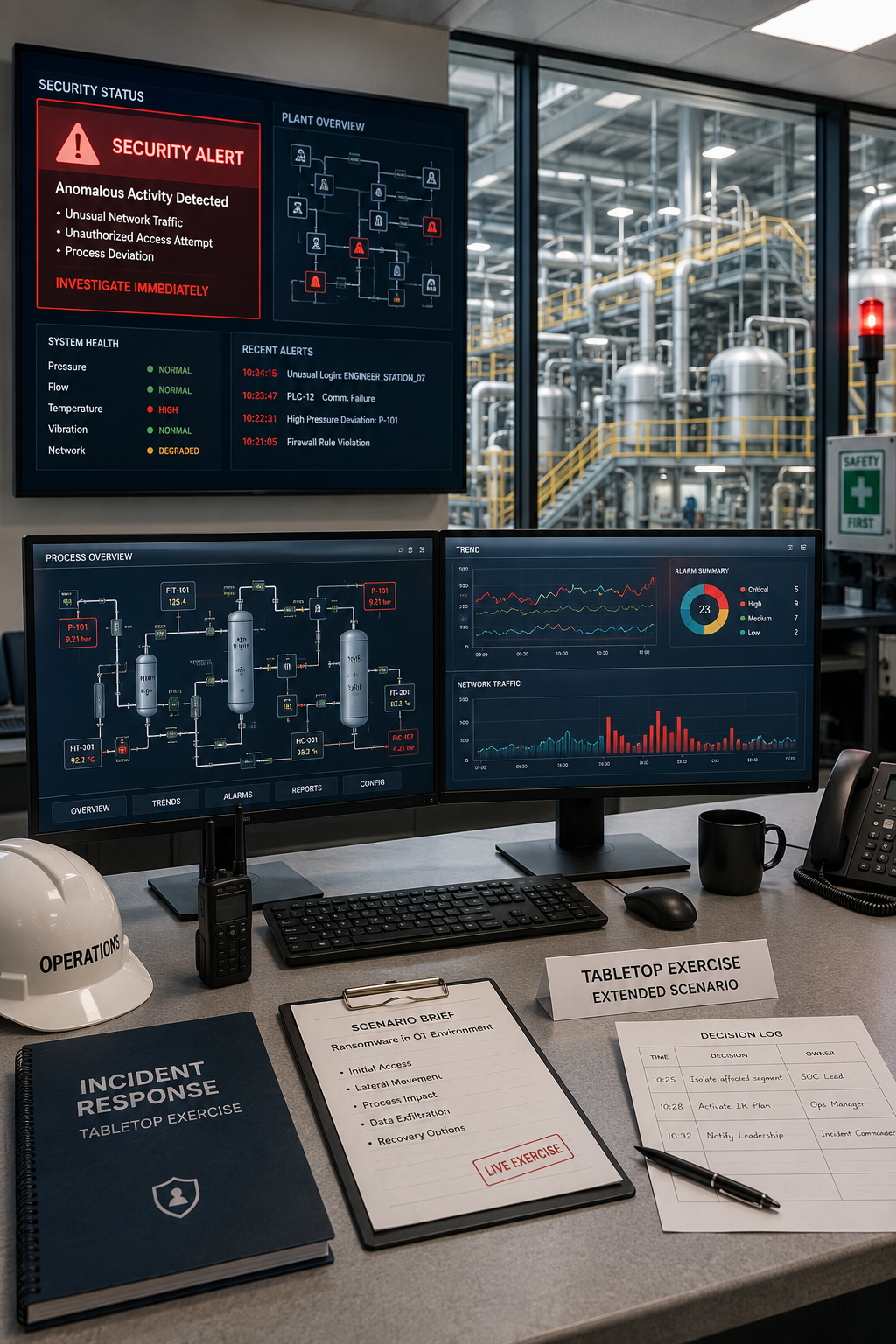
Two simulation variants:

A. Management-Level Simulation
Designed for senior leadership, legal, and communications teams.
- Strategic crisis decision-making
- Legal and regulatory reporting obligations
- Media and stakeholder pressure management
- Board-level accountability and communication


B. Technical-Level Simulation
Designed for IT, OT, and security operations teams.
- Detection and response workflow validation
- IT/OT segmentation and containment decisions
- Forensics coordination
- SOC integration and tooling
- Detailed containment and recovery sequencing

What Every Package Includes
What a Scenario Looks Like
A pressure-tested situation — not a theoretical quiz.
An exercise is not a presentation or a discussion about what you would do in theory. It is a structured simulation where your team must actually respond — in real time, with incomplete information, under time pressure.
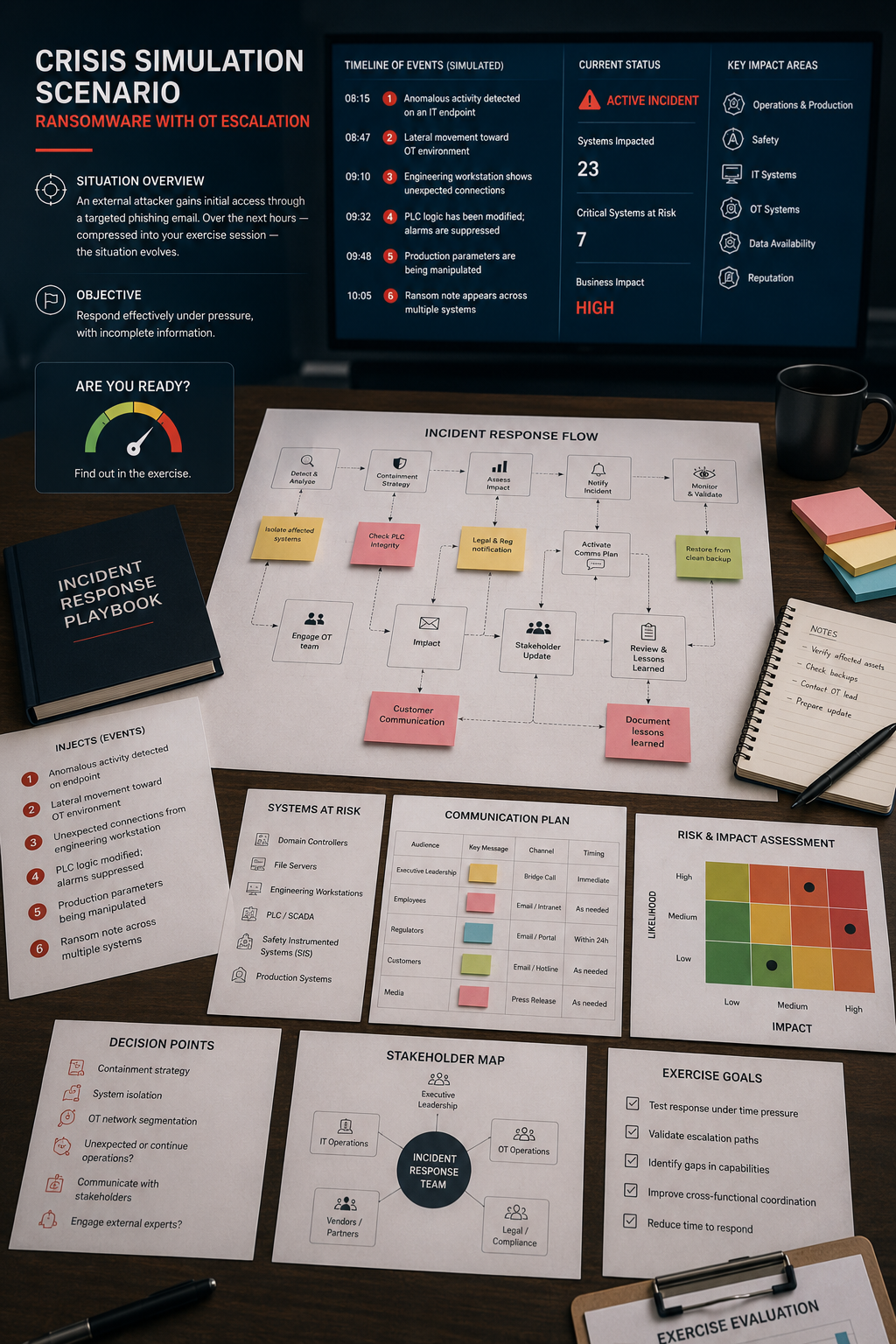
Example: Ransomware with OT Escalation
An external attacker gains initial access through a targeted phishing email. Over the next hours — compressed into your exercise session — the situation evolves
- Anomalous activity is detected on an IT endpoint
- The attacker moves laterally toward the OT environment
- Engineering workstations show unexpected connections
- PLC logic has been modified; alarms are suppressed
- Production parameters are being manipulated
- A ransom note appears across multiple systems
Your team must simultaneously manage: containment decisions, regulatory notification timing, communication with management and external partners, media inquiries, and escalating operational impact.
This is where most teams find their real gaps — not in knowing the right answers, but in coordinating effectively under pressure.
Other scenarios we run include business email compromise, insider data theft, supply chain backdoor, and targeted OT sabotage — each adapted to your sector and environment.
Unsure which package to choose?
Contact us for a no-obligation conversation and we will help you identify the right starting point.
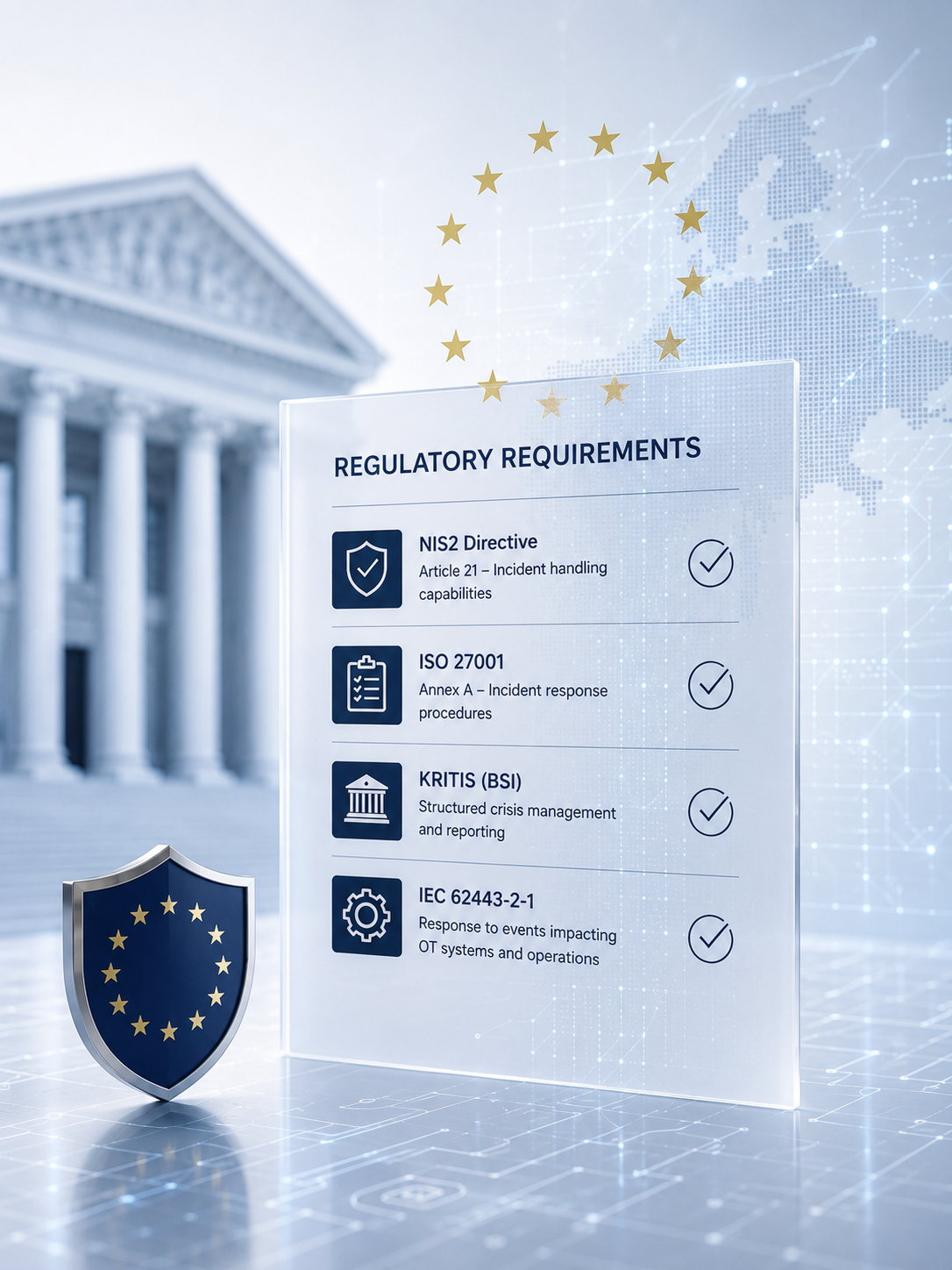
Compliance doesn't have to mean box-ticking.
Our exercises are designed to satisfy specific regulatory expectations — and to make your response capability genuinely stronger at the same time.
- NIS2 Directive — Article 21 requires essential and important entities to have tested incident handling capabilities. Our exercises generate documented evidence of compliance.
- ISO 27001 — Annex A controls require incident response procedures to be established and practiced. Exercise findings feed directly into your ISMS.
- KRITIS — German critical infrastructure operators must demonstrate structured crisis response and fulfill BSI reporting obligations. Our exercises simulate these pressure points explicitly.
- IEC 62443 — For OT environments, the Extended Exercise validates response against IEC 62443-2-1 program requirements.
Following an exercise, you receive documentation suitable for use in audits and regulatory reviews.
Frequently Asked Questions
Got questions? We’ve got answers. Here are some common queries about our CIRT360: eXercise
Each exercise is customized based on your industry, threat landscape, regulatory requirements, and organizational structure to ensure scenarios are realistic and relevant to your specific risks.
Key stakeholders involved in incident response should participate, including IT/security teams, management, legal, communications, and relevant business units.
A tabletop exercise focuses on decision-making, communication, and processes at an organizational level, whereas technical simulations or penetration tests focus on identifying technical vulnerabilities.
It is recommended to conduct tabletop exercises at least annually, or more frequently when there are significant changes in the organization, threat landscape, or regulatory environment.